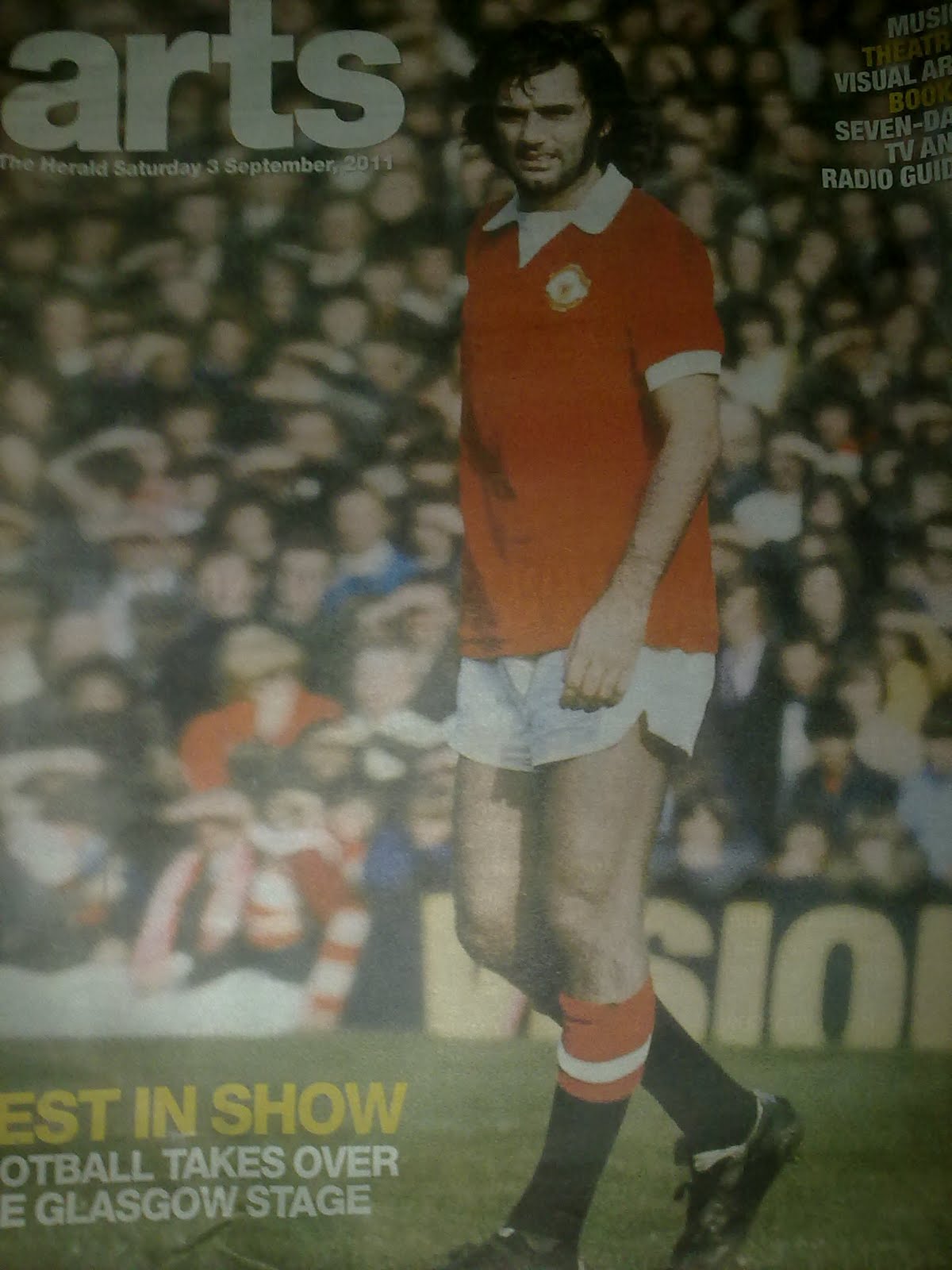
Essay of the week by Teddy Jamieson
Published on 22 May 2011
IT’S almost over. Next Saturday either Barcelona or Manchester United will be crowned champions of Europe and we can forget about football for a couple of weeks. Truth be told, there’s a lot to forget. This has not been a good season for the game. Superinjunctions, greedy players, allegations of corruption against Fifa, accusations of racism against the French FA and, closer to home, bullets in the post, a bomb in the mail, assaults on the pitch; in short an ugly eruption of sectarianism that has disfigured football in Scotland. In the last few months the game has been anything but beautiful.
It’s difficult, in the circumstances, to speak up for the sport. Difficult, too, to speak up for those who follow it – some of whom sing songs of hate, or jump over barriers and try to assault managers (or to be exact, one manager, Neil Lennon, who has become something of a lightning post for the worst excesses of the game). There’s nothing new in the argument that those of us in love with the sport are guilty of some kind of failing. As if our obsession makes us less mature, less grown-up. Big kids if you like. But in recent weeks a more baleful, ugly accusation has been emerging, that men’s – and in particular, Scottish men’s – relationship with football is toxic: poisoned and poisonous. That men who love football are not just emotionally undeveloped, they are frankly dysfunctional.
Pat Nevin, football-player-turned-commentator, argues that instead of discussing emotions, feelings and relationships, “men find it much easier just to talk about football and relate how they feel about things to football”. The danger, he says, is that the game becomes a substitute for real life, a way for men to swerve round the reality of their emotional lives. This also speaks to a more general criticism of the working-class Scottish male. The Glasgow academic Dr Ewan Gillon has argued that Scottish men too often use alcohol and violence as a means to numb feelings, and that emotional detachment – a stoic invulnerability if you like – is almost a mark of honour.
I can’t say that there is no truth in all of this. But it’s not the only truth. I would like to argue, quietly, modestly, in the sport’s defence, and in defence of those who love the game. To do so I’d like to tell you a story.
My wife’s cousin George died suddenly last June. A teacher, a mountaineer and, in later years, a political activist, George was not, by all accounts, much of a footballer. My late father-in-law, who could play a bit and was once offered a trial with Celtic, only for his Rangers-supporting mother to ban him from attending, loved to tell the story of a school game in which George was playing in goal. His side lost 16-0. “But it would have been much worse if I hadn’t been there,” the teenage George was reputed to have said at the time.
However, if he couldn’t play football, he knew the game. At one point he was a scout for Dundee United and could claim to have discovered the likes of Duncan Ferguson and Calum Davidson. And he loved to talk about it.
The last day I spent with George was at the football. Not a match actually, but some satellite telly Football X Factor event near Hampden at the start of last year. Even now, when I think of him, I can see him hirpling up and down the stone steps of the indoor sports arena that day aided by his walking stick, before sitting down beside me to talk about England’s chances in the World Cup (I think we disagreed on that) or the genius of Lionel Messi (no disagreement necessary there).
We’d gone to support my brother-in-law’s son, Ben, who was trying to impress a couple of coaches from Inter Milan. George was in his 60s, Ben in his teens and I’m in between. I’ve thought about that day a lot since George’s death. Ben didn’t catch the eye of the coaches. No-one did. But that disappointment apart, it was a good day, one that brought three generations together. Family and football were the glue.
That notion of football as a binding agent is so familiar it’s almost unremarkable. It constantly gets down-played. Why should it matter when football talk is – when it’s not contentious – unimportant? Certainly there is a constant white noise that now whines around the game, invading news broadcasts, radio talk-ins, newspaper headlines, a barely hidden hysteria that in times past would have been seen as unmanly. “We spend a bit too much time talking about how Wayne Rooney behaves,” argues Nevin. “I don’t care. I care about the football, about the artistry in the game, and I can get that conversation. But I’ve never been able to take part so much in that other, small-minded side.”
Nevin offers the concerned fan’s vision of the sport at the moment. A game that’s sold its soul, and whose fans have lost sight of what is and isn’t important. And so they phone radio talk-ins and vent about bad refereeing decisions, players who don’t care about the fans, managers who cup their hands to their head. But they still pay their money, go to the games, support the edifice. And they ignore other areas of their lives for football’s hopped-up, media-led, artificial drama.
There’s something in this. But the notion of the fan as willing dupe stretches only so far. Plenty of fans are morally engaged with the game. In the 1980s and 1990s fanzine culture and organisations such as the Football Supporters Association helped tackle the cancer of racial abuse then prevalent throughout the game. It worked to such an extent that French players Benoît Assou-Ekotto and Sébastien Bassong recently argued that England was a much more open society than its French counterpart. Closer to home, there is Neil Lennon’s story.
For the past couple of years I have been working on a book about sport in Northern Ireland during the Troubles. It has been a sobering reminder that sport in the province (and beyond) has been twisted by the political context that it found itself in. Sometimes that came in the shape of arguments over which country a sportsman or woman should represent, what flag they should walk behind. And sometimes it came in the shape of death threats.
So many Northern Irish sportspeople were victims of this cruelty. George Best, Mary Peters, Willie John McBride, and many more. In 2002 Neil Lennon became one of them. Lennon had played many times for his country before, but his move to Celtic in 2000 galvanised a vicious sectarian response. It climaxed with a telephoned death threat the day he was meant to captain his country against Cyprus. Lennon never played for Northern Ireland again.
But there is a sequel to this story. In the wake of the death threat Northern Ireland fans, backed by the IFA, decided to do something about it. They launched the Football For All scheme. They organised block bookings for international games at Windsor Park, outsang and outchanted the bigots, used the internet to engender a sense of community, stood up for a different vision of being a fan, one that refused the sectarianism. They spoke up for football and reshaped the identity of the national team’s support. Lennon’s situation was the catalyst for that. Sport may offer a platform for sectarian identity politics. But it can also offer a platform to challenge those politics.
Ultimately, though, I want to argue for something much simpler but perhaps just as fundamental. I want to return to that day with George and Ben and to the idea of football as a conduit, a connection that threads through generations, that common language which allows us to share a history and a sense of belonging. To the idea that our obsession with football is not a symptom of emotional detachment but a means of connection.
My father-in-law Wullie Stewart, when he wasn’t talking about George’s terrible goalkeeping, would tell me stories about watching Real Madrid beating Eintracht Frankfurt 7-3 in the European Cup final at Hampden Park in 1960, or being coached by former Scotland manager Bobby Brown. I’d hear family stories of the Ibrox disaster and the narrow margin between safety and disaster. Football was part of Wullie and George’s family story, to which I then added my own filigree (as a Spurs and Northern Ireland fan). It was a language we could share (even if it was only to agree to disagree). It helped sew us together. Nevin says the same about the fact that he and his 19-year-old son have discovered a new togetherness through their shared love of Hibernian football club.
There’s a danger that we sentimentalise the fan mentality without recognising its sharper, dirtier edges. But that doesn’t undermine the simple truth of it. “I have no doubt that much conversation about football reflects very deep literacies,” suggests broadcaster Stuart Cosgrove, “myth, history and shared communal memory among them. Because the noise around football is loud and abrasive, in Scotland we frequently miss out on nuance.” But it’s there if you look for it. “Last year a group of St Johnstone fans lobbied the local council to name a street in Perth after our recently deceased captain Drew Rutherford. The opening allowed fans to meet, share past anecdotes, fond memories and pay requiem. It is an example of the touching, almost reverential values that football can uniquely evoke.”
That’s defence enough in itself. But I’d like to go further, taking issue with Pat Nevin’s idea that football is a substitute for life. If anything, it is the opposite. When we talk about football we are actually displaying a form of emotional engagement.
The classic view of male conversation (the Men are from Mars theory) is described by clinical psychologist Oliver James as typically adversarial: “Men tend to say one thing then the other reacts. And it tends to be much less about the personal, about feelings and about details of emotional life with intimates, and more about impersonal subjects like politics and football.” Women, by contrast, are allegedly more willing and able to talk about emotions and feelings.
“But in reality,” says James, “men are expressing their emotions through their discussions of current affairs, football or whatever. Men are using football as a vehicle for their psychopathology ... subliminally communicating their state of mind.
“If I’m feeling down and trashing my team Chelsea my friend might try to cheer me up either by saying, ‘Chelsea aren’t as bad as you think’, or ‘You’re not as bad as you think’. Or empathise by weighing in with me. ‘Oh God, yes they’re rubbish aren’t they?’ Clearly, emotional transactions are going on.”
Football, then, is not a sign of our stunted emotional growth. For some men it can be a vehicle for emotional display in the same way as pop music, opera or Savile Row tailoring. More than that, football can be a vehicle to discuss issues that may be difficult to talk about in working-class male culture – notions of beauty, of aesthetics. “It doesn’t seem prissy to talk about the beauty of a goal and to share that beauty with another person and to jointly relish it,” agrees academic and football fan John Williams. “Whereas if you start talking about the beauty of Tolstoy’s prose everyone starts looking a little uneasy.”
In our hearts we are (nearly) all Barcelona fans. There is such a thing as the beautiful game. And maybe football also gives us a chance to discuss masculinity itself. When we talk about Wayne Rooney – his contract wrangles, his off-the-pitch problems – aren’t we also debating notions of responsibility, of loyalty?
What do we talk about when we talk about football? Yes, we talk about diabolical refereeing decisions, managers keeping someone on the pitch long after they’d proved they weren’t up to it. We talk about the money footballers are paid, the commercialism that’s overtaking the game, sometimes the corruption that infects it. And sometimes, particularly in Scotland, we talk about the orange and the green and how two football teams in Glasgow represent hundreds of years of, at times, bitter history. All of that is true.
But I think we talk about something more, too. When I speak to my friend Mark, who lives hundreds of miles away, our conversation often becomes a litany of goals and players we remember. Woven into that conversation are ideas about who we were, who we are, the values that underlie our affections and loyalties. And, I think, a notion of how we want the world to be. The great football writer Arthur Hopcraft once wrote: “What happens on the football field matters, not in the way that food matters but as poetry does to some people and alcohol does to others; it engages the personality.”
In other words, football is not an escape or a distraction or a means of emotional avoidance. For some of us it is central.
You could say it is part of who we are. And that doesn’t have to be a bad thing.